
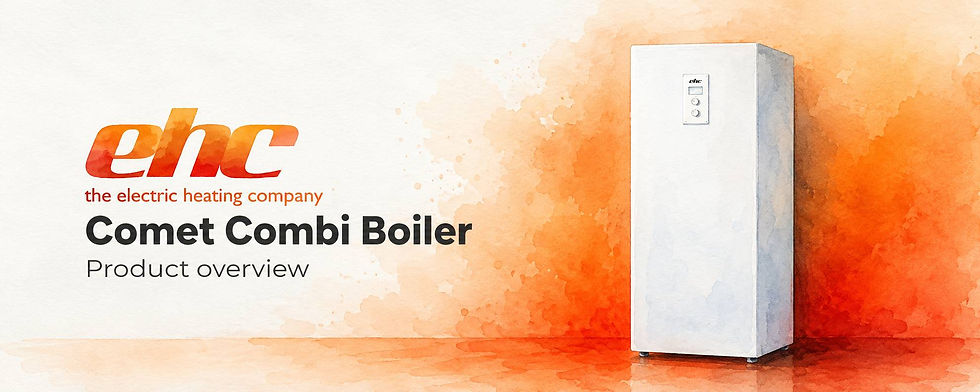
EHC Electric Boilers
Compare EHC flow, system and electric combi boilers, understand electrical-supply requirements and find the right heating solution for your property.
EHC electric boilers provide wet central heating for properties where mains gas is unavailable, unsuitable or no longer wanted.
The Electric Heating Company’s current range includes compact flow boilers, system boilers, electric combi boilers, boiler-and-cylinder packages and higher-output three-phase products. Available options include the EHC SlimJim, Comet PV, Fusion Astro and Fusion Comet ranges.
An electric boiler can operate with traditional radiators, underfloor heating or a separate hot-water cylinder. However, the boiler must be selected around the property’s calculated heat loss, electricity supply, hot-water demand and existing heating system.


APN Boilers helps homeowners find experienced heating and electrical professionals who can assess the property and recommend a suitable EHC electric boiler installation.
Is an EHC Electric Boiler Suitable for Your Home?
An EHC electric boiler may be considered where:
-
The property is not connected to mains gas
-
Installing an oil or LPG tank is impractical
-
A flue cannot easily be installed
-
The home already has wet radiators
-
An existing electric boiler requires replacement
-
A landlord wants a heating system without gas combustion
-
The property is a flat or apartment
-
Available space is limited
-
Solar photovoltaic panels are installed
-
A low-maintenance heating appliance is preferred
Electric boilers do not require a gas connection, combustion chamber, gas flue or external oil tank. They can therefore provide a practical solution for certain flats, small homes, conversions and off-grid properties.
However, electricity generally costs more per unit than mains gas, and a direct electric boiler does not multiply the energy it consumes in the way a heat pump can. Government guidance explains that a heat pump may produce around three units of heat for each unit of electricity used.
The installer should therefore compare:
-
Electric boiler installation
-
Air-source heat pump
-
Ground-source heat pump
-
High-heat-retention storage heating
-
Existing gas, oil or LPG heating
-
Improvements to insulation
-
Solar PV and battery storage
The lowest installation cost does not always result in the lowest long-term running cost.
The EHC Electric Boiler Range
The current EHC range includes products for small flats, normal domestic wet-heating systems, properties requiring hot-water cylinders and larger buildings with three-phase electrical supplies.
Principal options include:
-
EHC SlimJim electric flow boilers
-
EHC Comet PV electric system boilers
-
EHC Fusion Astro electric combi boilers
-
EHC Comet combination boiler and cylinder units
-
EHC boiler-and-cylinder packages
-
EHC all-in-one boiler and cylinder units
-
EHC Fusion Comet three-phase system boilers
Single-phase domestic boilers are available from approximately 4kW to 14.4kW, while three-phase products extend to considerably higher outputs for larger homes and commercial-style applications.
EHC SlimJim Electric Boilers
The EHC SlimJim is a compact electric flow boiler designed to provide central heating through a wet radiator or underfloor-heating system.
Current single-phase SlimJim models are available with outputs from approximately 4kW to 14.4kW. The range is designed for homes where cupboard and wall space are restricted.
An EHC SlimJim boiler may suit:
-
Flats and apartments
-
Small houses
-
Extensions and annexes
-
Holiday accommodation
-
Properties already using wet radiators
-
Underfloor-heating systems
-
Replacement of an older electric flow boiler
-
Installations using a separate hot-water cylinder
The SlimJim is primarily a flow boiler. It heats water circulating through the central-heating system but does not normally provide instantaneous domestic hot water on its own.
Hot water can be provided separately through:
-
An unvented hot-water cylinder
-
A vented cylinder
-
Direct electric immersion heating
-
A packaged boiler-and-cylinder arrangement
-
Separate instantaneous water heaters
The correct arrangement will depend on the number of bathrooms, available space and household hot-water use.
Choosing a SlimJim Boiler Output
Current SlimJim outputs include models around:
-
4kW
-
7kW
-
10kW
-
12kW
-
14.4kW
These output labels should not be matched to a property solely by bedroom count.
The installer should calculate:
-
Floor area
-
Wall, roof and floor construction
-
Insulation levels
-
Window sizes
-
Air leakage
-
Number and output of radiators
-
Underfloor-heating requirements
-
Design outdoor temperature
-
Desired internal temperature
-
Planned extensions or alterations
A small, well-insulated flat may require substantially less heating output than an older property of a similar floor area.
An oversized electric boiler may increase the required electrical load without improving comfort. An undersized appliance may struggle to maintain temperature during colder weather.
EHC Comet PV Electric System Boilers
The EHC Comet PV is a system-style electric boiler that can provide wet central heating and work with a separate hot-water cylinder.
Current single-phase versions offer selectable outputs between approximately 2kW and 14.4kW. Three-phase versions are available between approximately 12kW and 24kW.
The Comet PV includes system components such as an internal expansion vessel and can be configured for different heating-control arrangements.
A Comet PV boiler may suit:
-
Flats and houses with wet central heating
-
Properties using a separate hot-water cylinder
-
Homes with solar PV panels
-
Replacement of an existing electric system boiler
-
Heating systems divided into zones
-
Underfloor-heating installations
-
Properties requiring app-based control
-
Homes with higher heating requirements and a three-phase supply
EHC Comet PV and Solar Panels
The Comet PV is designed to operate as a standard electric boiler but can also be integrated with solar photovoltaic generation.
EHC states that the boiler can use excess electricity generated by compatible solar PV arrangements, subject to the controls and installation design. Optional app control is also available.
Solar PV may help reduce the amount of grid electricity used at certain times, but it should not be assumed that panels will provide all the energy required for winter heating.
Electric-boiler demand is often greatest:
-
During winter
-
In the morning
-
In the evening
-
During cold and overcast conditions
Solar production can be lower during those same periods.
The proposed installation should therefore consider:
-
Size of the solar array
-
Orientation and shading
-
Seasonal electricity production
-
Export arrangements
-
Battery capacity
-
Hot-water storage
-
Boiler controls
-
Household electricity consumption
-
Available grid supply
Solar PV can contribute to the system, but it does not remove the need to assess likely running costs.
EHC Fusion Astro Electric Combi Boiler
The EHC Fusion Astro is an electric combi boiler providing central heating and domestic hot water from one appliance.
The current Fusion Astro V2 range includes 12kW and 14.4kW single-phase models and 24kW and 30kW three-phase models. EHC positions the range primarily for smaller properties with a shower and hot-water outlets serving sinks.
An EHC Astro electric combi boiler may be suitable for:
-
Flats and apartments
-
Small houses
-
Properties with one shower
-
Homes with limited hot-water demand
-
Direct replacement of an electric combi boiler
-
Properties without space for a separate cylinder
-
Off-gas-grid accommodation
-
Annexes and smaller self-contained units
The Astro can operate with panel radiators or wet underfloor heating.
Electric Combi Boiler Hot-Water Performance
An electric combi boiler works differently from a high-output gas combi.
A normal domestic single-phase electricity supply limits the amount of instantaneous heat that can be produced. This means an electric combi may be well suited to a shower and sinks but may not fill a large bath as quickly as a powerful gas boiler.
Before recommending an electric combi, the installer should assess:
-
Number of bathrooms
-
Shower type
-
Required shower flow
-
Bath size
-
Simultaneous outlet use
-
Incoming water pressure
-
Incoming water flow
-
Electrical-supply capacity
-
Whether three-phase power is available
A property with several bathrooms or significant simultaneous hot-water demand may be better served by an electric system boiler and a correctly sized hot-water cylinder.
Stored hot water allows electricity to heat the cylinder over time instead of requiring the entire hot-water demand to be met instantaneously.
EHC Comet Combination Boilers
The EHC Comet Combination arrangement combines an electric boiler with a hot-water cylinder and associated system components.
This provides wet central heating and stored domestic hot water within a packaged installation. Current retailer listings include 9kW, 12kW and 14.4kW Comet combination units.
This arrangement may suit:
-
Flats with an airing-cupboard space
-
Homes requiring stronger stored-hot-water performance
-
Properties with a bath
-
Households wanting an immersion-heater backup
-
Replacement of an older electric boiler and cylinder
-
Homes where a conventional electric combi would be insufficient
-
Projects seeking a coordinated boiler and cylinder package
The cylinder capacity should be selected around the household rather than the boiler alone.
The installer should consider:
-
Number of occupants
-
Number of bathrooms
-
Bath capacity
-
Shower flow rates
-
Simultaneous demand
-
Cylinder recovery time
-
Available cupboard space
-
Water pressure
-
Heat losses from the cylinder
-
Immersion-heater provision
EHC Boiler and Cylinder Packages
EHC supplies boiler-and-cylinder packages using Comet PV or SlimJim boilers with cylinders of different capacities.
Current packages include cylinder sizes around 120, 150, 170, 200 and 250 litres, depending on the selected boiler and arrangement.
A smaller cylinder may suit a flat or one-person household. Larger cylinders may be required where the property has:
-
Several occupants
-
A full-sized bath
-
Two bathrooms
-
High-flow showers
-
Regular simultaneous use
-
A greater requirement for stored hot water
Oversizing should also be avoided. An unnecessarily large cylinder occupies more space and may store more hot water than the household regularly uses.
EHC All-in-One Boiler and Cylinder
EHC also offers all-in-one products that combine an electric boiler and unvented cylinder within one coordinated unit.
Different boiler outputs and cylinder capacities are available, providing a packaged heating and hot-water solution for properties where a single enclosed installation is preferred.
An all-in-one arrangement may be useful where:
-
A coordinated replacement package is preferred
-
The property has limited plant space
-
Installation time needs to be reduced
-
The household requires stored hot water
-
A conventional electric combi would not provide sufficient flow
-
A neat cupboard-based installation is required
The installer must still check the overall dimensions, weight, servicing access, discharge-pipe route and electrical demand.
EHC Fusion Comet Three-Phase Boilers
The Fusion Comet range provides higher heating outputs for properties and buildings with a three-phase electricity supply.
Current examples include 39kW and 48kW electric system boilers. EHC’s wider three-phase range extends towards 100kW for larger residential and commercial applications.
A higher-output Fusion Comet boiler may be relevant for:
-
Large houses
-
Apartment developments
-
Commercial premises
-
Schools and community buildings
-
Properties with extensive underfloor heating
-
Buildings divided into multiple heating zones
-
Projects replacing a large fossil-fuel boiler
-
Installations where three-phase electricity is already available
A three-phase boiler should not be specified before the electricity supply and distribution equipment have been assessed.
The project may require:
-
Confirmation from the electricity network operator
-
Three-phase metering
-
Upgraded incoming supply
-
New switchgear
-
Larger distribution boards
-
Dedicated electrical circuits
-
Load management
-
Changes to other high-demand appliances
These works can significantly affect the project cost.
Single-Phase or Three-Phase Electric Boiler?
Most normal houses and flats have a single-phase electricity supply.
Single-phase EHC boilers are generally available up to approximately 14.4kW. Larger outputs often require three-phase power.
A three-phase supply may be required where:
-
The calculated heat loss exceeds the practical single-phase output
-
A high-output electric combi is proposed
-
The property is particularly large
-
Several electric heating appliances will operate together
-
The existing electrical load is already substantial
-
Electric vehicle charging, induction cooking and battery systems are installed
The installer should assess the complete property load, not just the boiler.
A 14.4kW boiler operating at maximum output draws a substantial current. The existing main fuse, meter tails, consumer unit and available capacity must all be checked by a competent electrician.
Electrical-Supply Assessment
Before an EHC electric boiler is ordered, a qualified electrician should inspect:
-
Existing electricity supply
-
Main service fuse
-
Consumer unit
-
Available spare ways
-
Meter tails
-
Earthing and bonding
-
Cable route to the boiler
-
RCD or RCBO protection
-
Other high-load appliances
-
Electric vehicle charger
-
Electric shower
-
Induction hob
-
Immersion heaters
-
Solar PV and battery equipment
The boiler will normally require a dedicated electrical circuit designed around the appliance output and manufacturer’s instructions.
Part P of the Building Regulations requires domestic electrical work to be designed and installed to protect people from fire and electric shock. Notifiable work should be handled through Building Control or a suitably registered competent-person electrician.
The homeowner should receive the appropriate electrical installation certification after the work has been completed.
Electric Boilers and Existing Radiators
An EHC electric boiler can often be connected to existing wet radiators, but the radiators and pipework should be checked before installation.
The assessment should include:
-
Radiator sizes
-
Radiator condition
-
Existing flow temperature
-
Pipe diameters
-
Sludge and corrosion
-
Thermostatic radiator valves
-
System balancing
-
Pump requirements
-
Expansion arrangements
-
Heating zones
A new electric boiler will not correct blocked pipework, undersized radiators or poor water circulation.
The system may need:
-
Chemical cleaning
-
Power flushing where appropriate
-
New inhibitor
-
Replacement radiator valves
-
New circulation pump
-
System filter
-
Radiator balancing
-
Additional insulation
EHC Boilers and Underfloor Heating
Electric boilers can work effectively with wet underfloor-heating systems where the output and controls are properly designed.
Underfloor heating normally operates at a lower water temperature than traditional radiators. The installation may require:
-
Mixing valves
-
Manifolds
-
Separate pumps
-
Multiple heating zones
-
Floor-temperature limits
-
Individual room thermostats
-
Weather-responsive controls
-
Correctly spaced pipework
A property combining radiators and underfloor heating may require separate temperature circuits.
The boiler output should reflect the complete heating demand, including all floors and zones likely to operate together.
EHC Electric Boiler Prices
EHC electric boiler prices vary according to the output, boiler type, controls, electrical supply and hot-water arrangement.
Current retailer examples include:
EHC product / Indicative boiler-only price
SlimJim flow boiler Approximately £750–£880
Comet PV system boiler Approximately £1,270–£1,800
Fusion Astro electric combi Approximately £1,320–£1,760
Mercury electric combi Approximately £1,560–£1,930
Comet combination unit Approximately £3,090–£3,240
Boiler and cylinder package Approximately £1,720–£2,390
Fusion Comet three-phase boiler Approximately £2,150–£2,850
These are current retail examples and may change. They normally exclude installation, upgraded electrical supplies, controls, plumbing alterations and Building Regulations certification.
For broader project budgeting, the following allowances may be useful:
EHC installation / Indicative installed cost
Straight forward SlimJim replacement £1,800–£3,000
Comet PV system-boiler installation £2,200–£3,800
Fusion Astro electric combi installation £2,500–£4,500
Boiler and cylinder package £3,500–£6,500
All-in-one boiler and cylinder £4,000–£7,000
Three-phase boiler installation £5,000–£10,000+
Major electrical-supply upgrade Individually assessed
These are planning allowances rather than fixed APN quotations.
What Affects EHC Electric Boiler Costs?
The final cost may be affected by:
-
Boiler model and output
-
Single-phase or three-phase supply
-
Existing main-fuse capacity
-
Consumer-unit condition
-
New dedicated electrical circuit
-
Cable size and route
-
Electrical-supply upgrade
-
Boiler location
-
Existing radiator system
-
New pumps or expansion vessels
-
Hot-water cylinder
-
Unvented-cylinder installation
-
Discharge-pipe route
-
Heating controls
-
Solar PV integration
-
App-based controls
-
System cleaning
-
Radiator replacement
-
Underfloor-heating zones
-
Making good and decoration
A low boiler-only price may not reflect the cost of upgrading the electrical installation.
The electricity-supply assessment should therefore be completed before the homeowner commits to a specific boiler.
EHC Electric Boiler Running Costs
Electric-boiler running costs depend on:
-
Property heat loss
-
Boiler output
-
Number of heating hours
-
Thermostat settings
-
Electricity tariff
-
Insulation
-
Weather conditions
-
Hot-water consumption
-
Solar PV production
-
Battery storage
-
Heating-control strategy
A direct electric boiler converts purchased electricity into heat without combustion or flue losses. However, it typically consumes roughly one unit of electricity to provide one unit of heat.
A heat pump can potentially provide several units of heat from each unit of electricity consumed, making it important to compare both technologies before selecting direct electric heating. Government guidance gives a typical heat-pump example of around three units of heat for each unit of electricity.
An electric boiler may nevertheless remain appropriate where:
-
The property is small and well insulated
-
Heat demand is low
-
Installation of a heat pump is impractical
-
External equipment is restricted
-
The property is a flat
-
The system is used intermittently
-
Capital cost is a major consideration
-
Solar PV contributes to electricity use
A running-cost estimate should be based on the property’s annual heat requirement rather than the boiler’s maximum output alone.
EHC Boiler Replacement
A straightforward EHC boiler replacement may involve changing an existing electric boiler for a comparable modern model.
The installer should still inspect:
-
Existing boiler output
-
Electrical circuit
-
Consumer unit
-
Main fuse
-
Heating controls
-
Radiators
-
Heating pipework
-
Expansion vessel
-
Pump
-
Hot-water cylinder
-
System-water condition
-
Existing certification
An older electric boiler may have been installed when fewer high-load electrical appliances were present in the home.
The electrician should account for modern loads such as:
-
Electric vehicle charging
-
Electric showers
-
Induction cooking
-
Air conditioning
-
Solar batteries
-
Immersion heaters
The combined load may affect whether the existing supply remains adequate.
Replacing a Gas Boiler With an EHC Electric Boiler
A gas boiler can potentially be replaced with an EHC electric boiler while retaining the existing wet radiators.
The work may involve:
-
Removal of the gas boiler
-
Safe disconnection of the gas supply
-
Removal or sealing of the flue
-
New electrical circuit
-
Consumer-unit alterations
-
Changes to heating pipework
-
New controls
-
System cleaning
-
Condensate-pipe removal or alteration
-
Cylinder installation where required
-
Building Regulations certification
The project should compare running costs as well as installation costs.
For many normal houses, a heat pump may use considerably less electricity than a direct electric boiler. The Boiler Upgrade Scheme supports eligible heat pumps and biomass boilers but does not normally fund direct electric-boiler installations.
EHC Boiler Controls
Modern controls can prevent unnecessary electricity use and improve comfort.
Depending on the selected EHC system, controls may include:
-
Programmable room thermostat
-
Wireless thermostat
-
App-based control
-
Individual heating zones
-
Thermostatic radiator valves
-
Underfloor-heating thermostats
-
Hot-water scheduling
-
Solar PV diversion controls
-
Load management
-
Weather-responsive operation
The Comet PV can be configured with optional smart and app-based control. EHC also promotes modulation and modern control options across its Astro, Comet and SlimJim ranges.
The controls should be included in the original heating design rather than selected after the boiler has been fitted.
EHC Boiler Warranties
EHC’s current warranty information refers to a two-year parts-and-labour warranty, with additional conditional cover and extended-warranty products available for qualifying boilers. Warranty registration is required.
Homeowners should ask the installer to confirm:
-
Exact warranty applying to the boiler
-
Whether the warranty is standard or extended
-
Who will register the appliance
-
Registration deadline
-
Servicing requirements
-
Water-treatment requirements
-
Electrical-installation conditions
-
What documents must be retained
-
Who should be contacted if a fault develops
The written quotation should state the actual warranty period rather than referring generally to extended cover.
Use a Qualified Electrical and Heating Installer
An EHC electric boiler installation may require both wet-heating and electrical expertise.
The installation team should be competent to undertake:
-
Boiler sizing
-
Heating-system design
-
Radiator and underfloor-heating work
-
Unvented-cylinder installation where applicable
-
Electrical load assessment
-
Dedicated-circuit installation
-
Consumer-unit alterations
-
Testing and commissioning
-
Building Regulations notification
Electrical Safety First recommends using an electrician registered with a government-approved Part P scheme for domestic electrical work.
Where an unvented hot-water cylinder is installed, the installer must also hold the appropriate qualification for that work.
Following completion, the homeowner should normally receive:
-
Electrical Installation Certificate
-
Building Regulations compliance certificate where applicable
-
Boiler commissioning record
-
Cylinder commissioning documentation
-
Manufacturer warranty confirmation
-
Control instructions
-
System operating instructions
-
Itemised invoice
What Should an EHC Boiler Quote Include?
A complete EHC boiler quotation should identify:
-
Exact EHC model
-
Boiler output
-
Single-phase or three-phase arrangement
-
Heating-only, system or combi configuration
-
Hot-water cylinder size
-
Proposed boiler location
-
Electrical-supply requirements
-
Dedicated cable and circuit
-
Consumer-unit alterations
-
Main-fuse requirements
-
Heating controls
-
App or solar PV integration
-
Pump and expansion components
-
System cleaning
-
Chemical inhibitor
-
Radiator or underfloor-heating work
-
Removal of the existing boiler
-
Making good
-
Warranty period
-
Commissioning
-
Certification
-
VAT
-
Exclusions
-
Potential additional costs
This allows homeowners to compare quotations on a like-for-like basis.
A cheaper quotation may exclude the electrical upgrade, controls, cylinder work or system alterations required to make the boiler operate correctly.
Frequently Asked Questions
What is an EHC boiler?
EHC stands for the Electric Heating Company. It supplies electric flow, system and combination boilers for wet central-heating and hot-water systems.
Are EHC boilers electric?
Yes. The principal EHC boiler ranges use electricity rather than gas, oil or LPG to heat water for radiators, underfloor heating and domestic hot-water systems.
How much does an EHC electric boiler cost?
Boiler-only prices currently begin at approximately £750 for selected SlimJim flow boilers. Electric combi, boiler-and-cylinder and three-phase products can cost between approximately £1,300 and more than £3,000 before installation.
Which EHC boiler do I need?
The correct boiler depends on the property’s calculated heat loss, electricity supply, number of bathrooms, hot-water demand and whether a separate cylinder is required.
What is the EHC SlimJim boiler?
The SlimJim is a compact electric flow boiler available in single-phase outputs from approximately 4kW to 14.4kW. It is primarily used for wet central heating.
What is the EHC Comet PV?
The Comet PV is an electric system boiler with selectable outputs, smart-control options and potential integration with compatible solar PV arrangements.
Does EHC make an electric combi boiler?
Yes. The Fusion Astro V2 provides central heating and on-demand hot water. Current outputs include 12kW, 14.4kW, 24kW and 30kW models.
Can an EHC electric combi fill a bath?
It may be possible, but electric-combi hot-water performance is restricted by the available electrical output. Properties with baths or higher demand may be better served by an EHC boiler and stored-hot-water cylinder.
Can an EHC boiler work with existing radiators?
Yes, provided the existing radiators, pipework, controls and circulation system are suitable. The system should be inspected and cleaned where necessary.
Can an EHC boiler work with underfloor heating?
Yes. EHC boilers can serve wet underfloor heating where the output, water temperatures, manifolds and controls are designed correctly.
Does an EHC boiler require three-phase electricity?
Smaller EHC boilers can use a suitable single-phase supply. Higher-output models, including 24kW, 30kW, 39kW and 48kW products, generally require three-phase electricity.
Are EHC electric boilers cheap to run?
Running costs depend on the property’s heat loss, electricity tariff and heating use. Direct electric boilers can be practical for small or low-demand properties, but a heat pump will generally use less electricity to provide the same amount of heat.
Can solar panels power an EHC boiler?
Solar panels can contribute electricity, and the Comet PV can be integrated with compatible PV control arrangements. However, winter solar generation may not cover the full heating requirement.
Can I receive a government grant for an EHC boiler?
The Boiler Upgrade Scheme supports eligible heat pumps and certain biomass installations. It does not normally provide funding for a direct electric boiler.
Who can install an EHC electric boiler?
The heating work should be completed by a competent heating installer, while the electrical supply, circuit and certification should be handled by a suitably qualified electrician. Notifiable domestic electrical work must comply with Part P in England and Wales.
Find the Right EHC Electric Boiler for Your Home
Choosing the right EHC electric boiler starts with understanding the property’s heat loss, existing heating system, electrical supply and hot-water requirements. APN Boilers can connect you with experienced local heating and electrical professionals who can assess the radiators, pipework, consumer unit and available power, recommend a suitable EHC flow, system or electric combi boiler and provide a clear quotation for the complete installation.
Tell us about your property and existing heating arrangements to take the next step towards a safe, controllable and properly designed electric-heating system.