
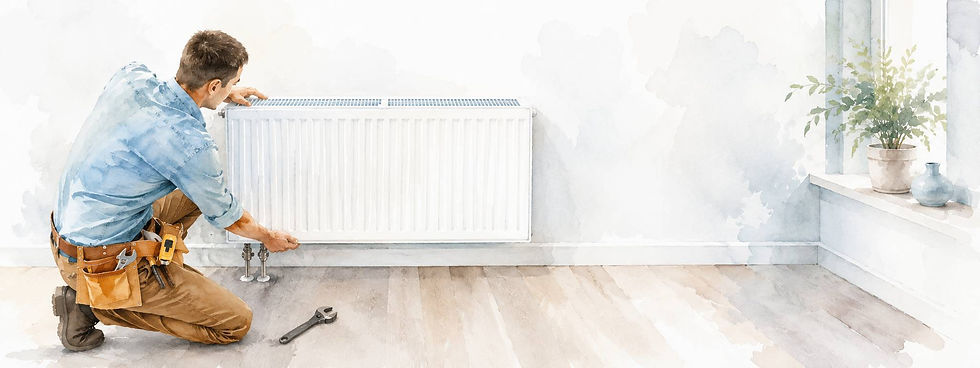
Changing and Adding Radiators
Correctly sized radiator replacement, additional radiators, upgraded valves and professional heating-system balancing.
Changing a radiator can improve the appearance, comfort and performance of a room.
A radiator may need replacing because it is leaking, corroded, damaged, difficult to control or no longer large enough to heat the space effectively. Homeowners may also want to add an extra radiator when extending a property, converting a room or improving a cold part of the home.
The work can range from a straightforward like-for-like radiator change to a more involved heating-system alteration requiring new pipework, upgraded valves, boiler-capacity checks and system balancing.
APN Boilers helps homeowners find experienced local heating professionals for


additional radiators, valve upgrades and central-heating improvements throughout the UK.
When Should You Change a Radiator?
A radiator may need changing where:
-
It is leaking from the panel or connections.
-
Rust or corrosion is visible.
-
It has persistent cold areas.
-
The radiator has been repeatedly repaired.
-
Existing valves are seized or leaking.
-
The room remains cold when the rest of the home is comfortable.
-
The radiator is undersized.
-
The property has been better insulated.
-
A room has been enlarged or altered.
-
The homeowner wants a modern or decorative design.
-
The heating system is being prepared for lower flow temperatures.
-
An old radiator is being replaced during renovation.
Cold areas do not automatically mean the radiator must be replaced. Air, sludge, poor balancing, restricted pipework, a defective valve or inadequate circulation can all reduce radiator performance.
The heating engineer should establish the cause before recommending a new radiator.
Like-for-Like Radiator Replacement
A like-for-like replacement involves installing a radiator with similar dimensions and connection positions to the existing model.
This can reduce the amount of pipework alteration and decorative making good required.
The work will normally involve:
-
Isolating or draining the heating system.
-
Removing the existing radiator.
-
Inspecting the valves and pipe connections.
-
Installing new wall brackets.
-
Connecting the replacement radiator.
-
Refilling and venting the system.
-
Checking for leaks.
-
Adding or checking corrosion inhibitor.
-
Balancing the heating system where required.
Even where the dimensions are similar, a modern radiator may have a different heat output. The replacement should be checked against the room’s heating requirement rather than selected from width and height alone.
Choosing a Different Radiator
A homeowner may use the replacement as an opportunity to install:
-
A larger panel radiator.
-
A double-panel radiator.
-
A vertical radiator.
-
A low-level radiator.
-
A column radiator.
-
A bathroom towel radiator.
-
A decorative radiator.
-
A low-temperature radiator.
-
A fan-assisted heat emitter.
Changing the radiator style can affect:
-
Heat output.
-
Required wall space.
-
Pipe positions.
-
Weight and wall fixings.
-
Furniture layout.
-
Curtain positions.
-
Heating-water volume.
-
Warm-up time.
-
The cost of installation.
A narrow vertical radiator may look attractive but should not be assumed to produce the same heat as a wider conventional radiator. The published output of the proposed model should be compared with the calculated requirement of the room.
Correct Radiator Sizing
Radiator size should be based on the heat lost from the room.
The assessment should consider:
-
Room dimensions.
-
Ceiling height.
-
External wall area.
-
Wall construction.
-
Floor and roof construction.
-
Insulation.
-
Window size and performance.
-
Number of external doors.
-
Air leakage and draughts.
-
Room use.
-
Desired temperature.
-
Proposed heating-water temperature.
Two rooms of identical floor area can require very different radiator outputs because of their construction and exposure.
A radiator that is too small may leave the room cold or require unnecessarily high boiler temperatures. An oversized radiator can allow the room to heat effectively at lower water temperatures, provided it is controlled correctly.
Radiator Outputs and Flow Temperatures
Radiator manufacturers normally publish outputs using stated test temperatures.
The actual heat delivered within the home depends on the difference between the average radiator-water temperature and the room temperature.
A radiator operating with lower-temperature water will produce less heat than the same radiator supplied at a higher temperature. This matters when:
-
Reducing the flow temperature of a condensing boiler.
-
Installing a heat pump.
-
Preparing the property for a future heat pump.
-
Replacing an old high-temperature heating system.
-
Improving boiler efficiency.
Energy Saving Trust explains that lower boiler flow temperatures can improve the efficiency of a condensing boiler, but the radiators must remain capable of heating the rooms at the chosen setting.
In some cases, fitting larger radiators can improve comfort while allowing the heating system to operate at a lower temperature.
Adding a Radiator to an Existing System
Homeowners may want to add a radiator to an existing system when:
-
Building an extension.
-
Converting a garage.
-
Completing a loft conversion.
-
Dividing a large room.
-
Turning a cupboard or storage area into a room.
-
Creating a home office.
-
Installing heating in a conservatory or garden room.
-
Improving an existing cold room.
Adding a radiator requires more than connecting it to the nearest visible pipe.
The installer should assess:
-
The room’s required heat output.
-
Boiler or heat-pump capacity.
-
Existing pipe sizes.
-
Available water flow.
-
Pump capacity.
-
Heating zones.
-
The position of nearby flow and return pipes.
-
Floor and wall construction.
-
Access beneath floors.
-
The condition of the existing heating system.
-
How the new radiator will be controlled.
GOV.UK identifies the addition of a radiator to an existing heating system as work that may require Building Regulations notification in some circumstances. The position should therefore be checked where the work forms part of an extension, new heating system or wider controlled project.
Can the Existing Boiler Support Another Radiator?
Adding one normal radiator will not automatically require a larger boiler.
Many existing boilers have some spare capacity, and older appliances are often oversized relative to the current heat demand. However, this should not simply be assumed.
The heating professional should consider:
-
Existing radiator output.
-
New radiator output.
-
Property heat loss.
-
Boiler output.
-
Boiler minimum modulation.
-
Hot-water requirements.
-
Previous extensions.
-
Heating-pipe sizes.
-
Pump performance.
-
Whether the existing system already struggles.
Where several radiators are being added as part of a large extension or loft conversion, the complete heating load should be recalculated.
A larger boiler cannot compensate for restricted pipework, inadequate pumps or poorly sized radiators.
Adding an Extra Radiator
The easiest route for adding an extra radiator is not always the best hydraulic connection.
The new radiator should normally connect into suitable heating flow and return pipes. Connecting incorrectly can lead to:
-
Poor circulation.
-
One-pipe operation.
-
Slow heating.
-
Uneven radiator temperatures.
-
Excessive noise.
-
Existing radiators becoming cooler.
-
Difficulty balancing the system.
The installer should identify whether the heating system uses:
-
Conventional two-pipe distribution.
-
A one-pipe system.
-
Microbore pipes.
-
Manifold distribution.
-
Separate heating zones.
-
Underfloor heating.
-
A combination of different arrangements.
Older one-pipe and microbore systems can require particular care when additional emitters are proposed.
Radiator Pipework
Radiator replacement may require alterations to:
-
Copper pipes.
-
Plastic heating pipes.
-
Microbore pipes.
-
Floor-level connections.
-
Wall connections.
-
Concealed pipes.
-
Pipe sleeves and covers.
-
Isolation and drain points.
The cost and disruption will be influenced by whether the pipes are:
-
Exposed.
-
Beneath floorboards.
-
Within a solid floor.
-
Concealed inside walls.
-
Behind fitted furniture.
-
Located above a finished ceiling.
Where a radiator is being moved to a different wall, the installer should agree the pipe route before work starts.
A neat installation should also consider how the finished pipes will look after flooring and decoration are completed.
Changing Radiator Valves
Radiator replacement provides a good opportunity to change old or defective valves.
The radiator will normally have:
-
A control valve or thermostatic radiator valve.
-
A lockshield valve used to regulate water flow.
Old valves may be:
-
Leaking.
-
Seized.
-
Difficult to adjust.
-
Incorrectly sized.
-
Poorly positioned.
-
Incompatible with modern controls.
-
Unsuitable for the new radiator.
Replacing the radiator while retaining deteriorated valves can lead to leaks or control problems shortly after installation.
Thermostatic Radiator Valves
A thermostatic radiator valve, commonly known as a TRV, senses the air temperature around the valve and adjusts the flow of heating water through the radiator.
TRVs allow rooms to be maintained at different temperatures and can reduce unnecessary heating in rooms that are not in constant use. Energy Saving Trust recommends using TRVs to control individual room temperatures rather than relying solely on one setting for the whole home.
Applicable Part L guidance states that a TRV should not normally be used on the radiator in the same room as the main room thermostat; the emitter in that room should generally have manual control so that the thermostat can sense and control the heating system properly.
The precise controls should be designed around the boiler, thermostat and zoning arrangement.
Smart Radiator Valves
Smart radiator valves can provide individual schedules and temperature control for different rooms.
They may be useful where:
-
Bedrooms are heated at different times.
-
Part of the property is used as a home office.
-
Guest rooms are rarely occupied.
-
The household has varied routines.
-
The homeowner wants app-based control.
-
Different floors have different heating requirements.
Smart radiator valves should be checked for compatibility with:
-
The central heating controller.
-
Boiler controls.
-
Existing thermostats.
-
Heating zones.
-
The communication system used by the manufacturer.
Smart controls can improve controllability, but they will not correct undersized radiators, restricted pipes or an unbalanced system.
What Is Radiator Balancing?
Radiator balancing regulates the flow of heating water through the radiators so that each receives an appropriate share.
Without balancing, radiators close to the boiler or pump may become hot quickly while those further away remain cooler.
Balancing may involve:
-
Fully opening the control valves.
-
Adjusting lockshield valves.
-
Monitoring radiator temperatures.
-
Confirming adequate flow through distant radiators.
-
Checking pump settings.
-
Bleeding trapped air.
-
Testing the system after adjustment.
Changing or adding a radiator can alter the resistance and flow within the heating system. The installer should therefore check whether the system needs rebalancing once the work is complete.
Cold Radiators and Sludge
A radiator with a cold area near the bottom may contain corrosion debris or sludge.
Possible remedies include:
-
Removing and flushing the individual radiator.
-
Cleaning the complete heating system.
-
Checking the magnetic filter.
-
Replacing severely corroded radiators.
-
Adding corrosion inhibitor.
-
Investigating the source of continuing contamination.
Replacing one blocked radiator may improve that room without resolving contamination elsewhere in the system.
Where several radiators have cold areas or filters repeatedly collect large amounts of debris, wider system cleaning and water-quality investigation may be appropriate.
Corrosion Inhibitor
Central-heating water should be suitably treated to reduce internal corrosion.
When a radiator is changed, the system may need to be partially or completely drained. The installer should check whether inhibitor needs to be replenished when the system is refilled.
Effective treatment helps protect:
-
Radiators.
-
Heating pipes.
-
Pumps.
-
Valves.
-
Boiler heat exchangers.
-
Magnetic filters.
-
Other water-containing components.
The installer should also check for leaks or regular pressure loss, because repeatedly introducing fresh water can dilute treatment and introduce additional oxygen into the system.
Radiator Position
Radiators are traditionally positioned beneath windows because this often helps counteract heat loss and cold downdraughts.
However, modern insulation and glazing can allow greater flexibility.
The position should consider:
-
External walls.
-
Windows and doors.
-
Furniture.
-
Curtains.
-
Beds and wardrobes.
-
Television positions.
-
Kitchen units.
-
Available pipe routes.
-
Heat circulation.
-
Future decorating.
-
Access to valves.
Radiators should not be tightly enclosed behind furniture or heavy curtains, as this can restrict heat circulation into the room.
Decorative covers can also reduce useful heat output and should be considered when the radiator is sized.
Vertical Radiators
Vertical radiators are commonly used where wall width is limited.
They can be useful in:
-
Kitchens.
-
Hallways.
-
Extensions with large glazed doors.
-
Bathrooms.
-
Narrow bedrooms.
-
Open-plan spaces.
The installer should confirm:
-
Required output.
-
Wall construction.
-
Fixing strength.
-
Pipe positions.
-
Valve orientation.
-
Clearance from ceilings and furniture.
-
Manufacturer installation requirements.
Large vertical radiators can be heavy. Suitable fixings and structural support are important, particularly where walls are formed from plasterboard or lightweight construction.
Bathroom Radiators and Towel Rails
A heated towel rail can warm towels and contribute to bathroom heating.
However, a small towel rail may not provide enough output to heat the complete room, particularly when covered with towels.
The calculation should consider:
-
Bathroom size.
-
External walls and windows.
-
Ventilation.
-
Desired room temperature.
-
Proposed water temperature.
-
The reduced output when towels cover the rail.
Where an electric element is incorporated, the electrical work must comply with the applicable safety requirements for dwellings and bathroom locations. Approved Document P covers the design, installation, inspection and testing of electrical work in homes in England.
Radiators and Heat Pumps
A property changing from a gas or oil boiler to a heat pump may need larger radiators.
Heat pumps generally achieve their best performance when heating water to a lower temperature than a traditional boiler. The radiators must therefore provide the required room output at that lower temperature.
Possible upgrades include:
-
Larger panel radiators.
-
Double- or triple-panel radiators.
-
Low-temperature radiators.
-
Fan-assisted emitters.
-
Wet underfloor heating.
-
Improvements to insulation and draught proofing.
The radiator schedule should be based on room-by-room heat-loss calculations rather than replacing every radiator automatically.
Replace Radiator Cost
The replace radiator cost depends on more than the price of the radiator.
A straightforward replacement using existing valves and connection positions will normally cost less than moving the radiator or installing new pipes.
The price may be affected by:
-
Radiator type and size.
-
Standard or decorative design.
-
Horizontal or vertical arrangement.
-
New valves.
-
Smart controls.
-
Pipework alterations.
-
Floor construction.
-
Wall strengthening.
-
System draining.
-
Inhibitor.
-
System cleaning.
-
Balancing.
-
Removal of the old radiator.
-
Making good.
-
Parking and access.
-
VAT.
A low radiator price may exclude valves, brackets, pipe fittings, installation and disposal.
Radiator Change Cost
The radiator change cost will generally be lower where:
-
The new radiator uses the same connections.
-
Existing valves are serviceable.
-
Floor coverings do not need lifting.
-
The wall is suitable for new brackets.
-
The heating system can be isolated locally.
-
No sludge or pipework defects are discovered.
Costs can increase where:
-
The radiator is moving to another wall.
-
Pipes are concealed within a solid floor.
-
New flow and return pipes are required.
-
The new radiator is substantially heavier.
-
Decorative making good is extensive.
-
The system requires cleaning.
-
Several seized valves need replacing.
-
The heating system cannot be isolated easily.
The quotation should separate the radiator supply cost from labour, valves, pipework and making good.
Radiator Replacement Near Me
When searching for a radiator replacement near me, homeowners should choose someone who can assess the heating system rather than simply install the selected product.
Ask whether the quotation includes:
-
Checking the required radiator output.
-
Supplying the radiator.
-
New wall brackets.
-
New valves.
-
Pipework alterations.
-
Draining and refilling.
-
Corrosion inhibitor.
-
Leak testing.
-
Venting.
-
Heating-system balancing.
-
Removal of the old radiator.
-
Making good.
-
VAT.
Where the work involves opening or altering a gas boiler or gas pipework, it must be undertaken by an appropriately qualified Gas Safe registered engineer. Gas Safe Register is the official register of businesses and engineers legally permitted to carry out gas work.
A radiator-only plumbing alteration will not necessarily involve gas work, but the contractor should understand the complete heating system and know when a Gas Safe engineer is required.
Building Regulations
Changing one existing radiator on a like-for-like basis will not usually require a separate Building Regulations application.
The position may be different where:
-
A radiator is added as part of an extension.
-
A complete heating system is being installed.
-
The heat source is being replaced.
-
New electrical work is involved.
-
The work affects an unvented hot-water system.
-
Structural alterations are required.
-
The project forms part of other controlled building work.
GOV.UK advises checking whether approval is required before altering building-services systems and notes that competent-person schemes can avoid the homeowner needing to submit an application personally for work covered by the scheme.
Building standards and notification procedures differ across England, Wales, Scotland and Northern Ireland.
What Should a Radiator Quotation Include?
A detailed quotation should identify:
-
Radiator manufacturer and model.
-
Dimensions and heat output.
-
Finish and colour.
-
Valve type.
-
TRV and lockshield arrangements.
-
Pipework alterations.
-
New brackets and fixings.
-
Floor or wall opening.
-
Draining and refilling.
-
Inhibitor.
-
System cleaning where required.
-
Balancing.
-
Testing.
-
Removal of the old radiator.
-
Making good.
-
VAT.
-
Exclusions and provisional costs.
Where a radiator is being added, the installer should explain how the required output was selected and where the new pipes will connect to the existing system.
Find a Radiator Installer Through APN Boilers
APN Boilers helps homeowners find experienced local professionals for:
-
Changing a radiator.
-
Radiator replacement.
-
Adding a radiator.
-
Adding an extra radiator.
-
Moving a radiator.
-
Installing vertical radiators.
-
Installing towel radiators.
-
Changing radiator valves.
-
Installing thermostatic radiator valves.
-
Heating-system balancing.
-
Radiator and pipework upgrades.
-
Preparing heating systems for lower temperatures.
Tell APN Boilers your postcode, room size, existing radiator dimensions and whether the radiator will remain in the same position.
We will help you find an appropriate local professional to assess the radiator change cost and complete the work.